You've bought the car. Handshake done, money transferred. Now comes the part nobody talks about: how do you actually get it home?
Before you collect it, four things need sorting. Confirm collection time and location with the seller or auction. Check the car's legally fit to move. Decide whether you're driving it yourself or booking transport. Get your paperwork sorted. Get those right and everything else flows. Skip them and you can end up stuck forty miles from home with a car you can't legally drive and no way to shift it.
I'm Danny Crangle. I collect and transport vehicles for a living out of Ballymena. This is the process I use, not a generic checklist from somewhere else.
Quick Checklist Before You Head Out
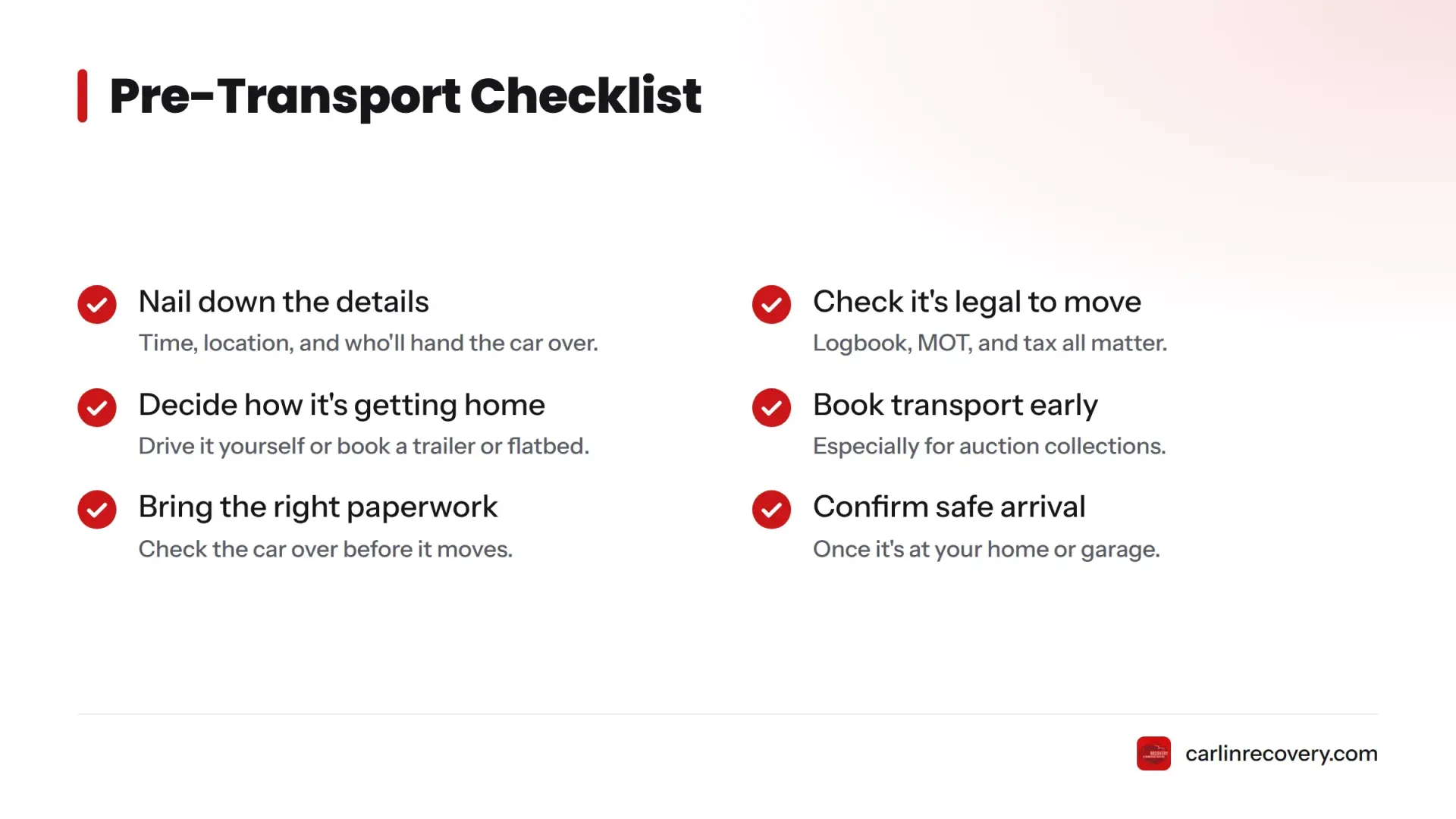
- Nail down the details. Time, location, and who'll hand the car over.
- Check it's legal to move. Logbook, MOT, and tax all matter.
- Decide how it's getting home. Drive it yourself or book a trailer or flatbed.
- Book transport early if you need it, especially for auction collections.
- Bring the right paperwork and check the car over before it moves.
- Confirm safe arrival once it's at your home or garage.
That's the whole job. Here's where people trip up with each one.
Step 1: Confirm Collection Details
Nail down a time and place before you commit to anything else. If you're collecting from a private seller, agree the exact address, a realistic time window, and confirm someone will be there with the keys and documents. I've turned up to collect vehicles where the seller assumed I knew the plan and hadn't actually confirmed it. A phone call the day before saves everyone a wasted journey.
Get collection details in writing where you can, even a text message. Confirm:
- The full address, including gate codes or access instructions for rural locations.
- Whether the seller will be there or if someone else is handing it over.
- A realistic time window, not just "sometime Saturday."
Collecting from an auction is different. Auction sites run to a strict schedule. Before you turn up:
- Check the collection window. Most sites hold vehicles for a set number of days before storage charges kick in.
- Confirm what ID you need to prove you're the buyer.
- Ask whether the car has a current MOT and tax. Many auction cars don't.
- Find out if the site has its own loading bay or ramp, or if you'll need to bring your own equipment.
If you're not ready to move the vehicle within that window, you'll pay storage on a car you haven't even driven yet.
Step 2: Check The Vehicle Is Legally Ready To Move
This is the step people skip, and it causes the real headaches. Before you decide how you're getting the car home, you need to know if it's actually legal to drive on the road.
The V5C logbook proves ownership. When you buy a car, the seller should hand you the green "new keeper" slip from the V5C. You don't need a new V5C in your name before you drive away, but you should always get that new keeper slip at handover. Without it, you've got no proof the seller actually sold it to you.
MOT and tax are non-negotiable. A car needs valid MOT and tax to be driven on a public road. Very few exceptions exist. If the car you've bought doesn't have both, you cannot legally drive it home. You can check MOT and tax status for free before you even arrange collection, using the official vehicle tax and MOT checker on GOV.UK, which covers vehicles registered in Northern Ireland and Great Britain.
No valid MOT or tax? Then you're moving to transport instead of driving. A vehicle carried on a trailer or flatbed isn't "in use" on the road in the same way, which is exactly why these services exist.
Step 3: Decide Between Driving It Home Or Booking Transport
Once you know the car's legal status, this decision often makes itself.
Drive it yourself when:
- The car has valid MOT and tax.
- You've got insurance cover in place (check with your insurer; your existing policy may extend to a newly bought vehicle, but don't assume).
- The distance is short and you're confident the car is roadworthy.
- You've already driven it and it feels solid.
Book transport instead when:
- The car isn't taxed or doesn't have a valid MOT.
- It's a non-runner or has a fault that makes driving unsafe.
- You bought it from an auction and have no history with it.
- You don't have insurance cover yet.
- It's a long distance and you'd rather not add miles to a car you've just bought.
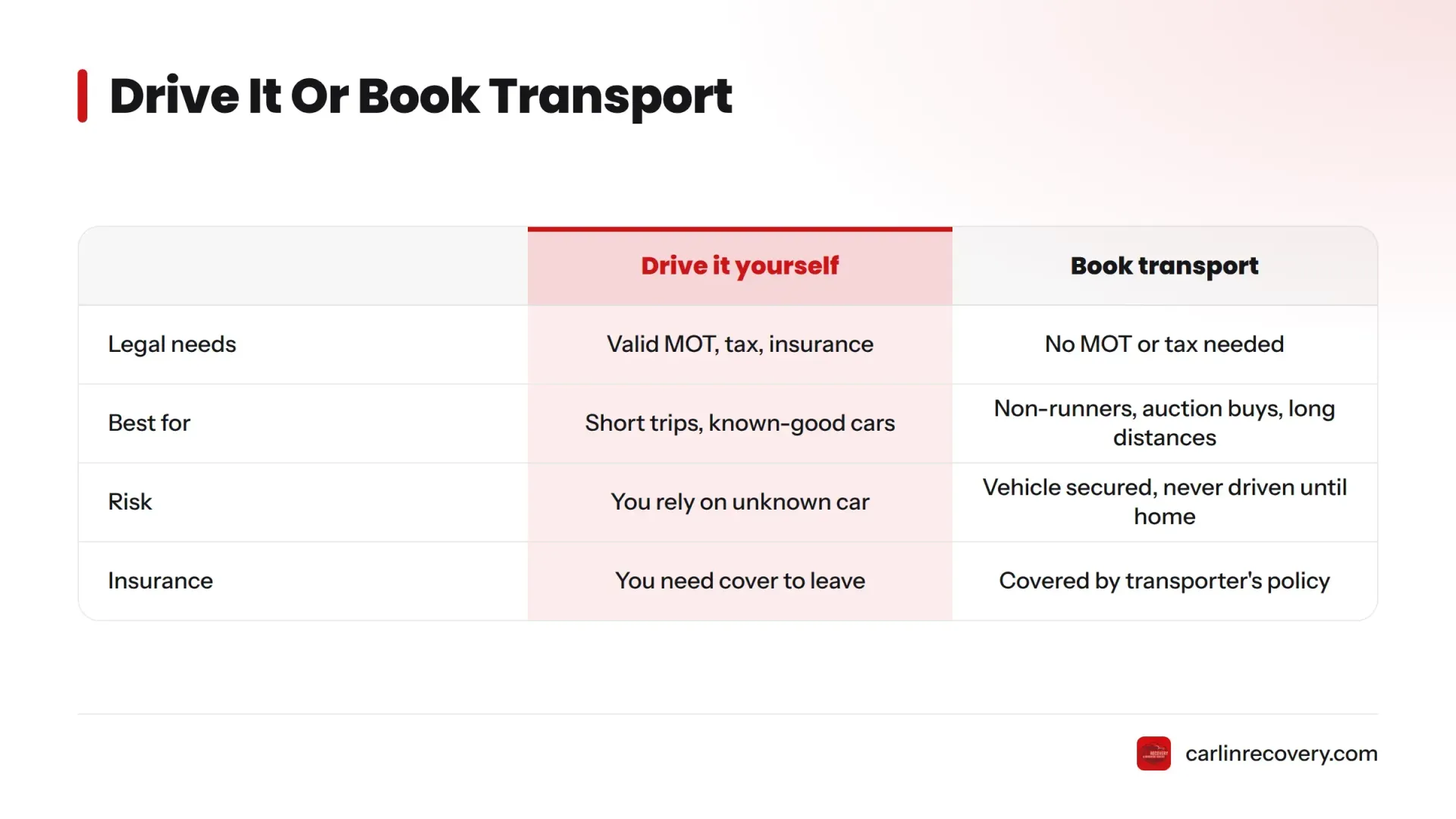
| Drive it yourself | Book trailer or flatbed | |
|---|---|---|
| Legal needs | Valid MOT, tax, and insurance cover | No MOT or tax needed |
| Best for | Short trips, known-good cars | Non-runners, auction buys, long distances |
| Risk | You rely on an unknown car | Vehicle is secured and never driven until home |
| Insurance | You need cover before you leave | Covered under the transporter's policy |
If you're ever unsure, book transport. It costs a phone call. Driving an untaxed or unroadworthy car risks a fine and a breakdown beside a road in a vehicle you don't know.
Here's a short video on choosing transport over a long drive, which applies equally to a short hop across County Antrim:
Step 4: Book Pre-Arranged Vehicle Collection
Once you know you need transport, book it as early as you can, especially if you're working to an auction deadline.
What a pre-booked collection covers:
- Agreeing the pickup location (private address, dealer, auction yard).
- Confirming drop-off point (your home, garage, or elsewhere).
- Loading the car safely onto a trailer or flatbed, properly secured for the journey.
- Handling the handover paperwork at both ends so you're not trying to coordinate two locations at once.
I run vehicle transportation across Northern Ireland, generally within around 60 miles of Ballymena. If you're buying further afield or from an auction outside that radius, ask early whether it's within reach rather than assuming and getting caught out closer to collection day.
Step 5: Prepare For Collection Day
Whether you're driving the car yourself or having it collected, turn up prepared. Here's what I check and bring every time:
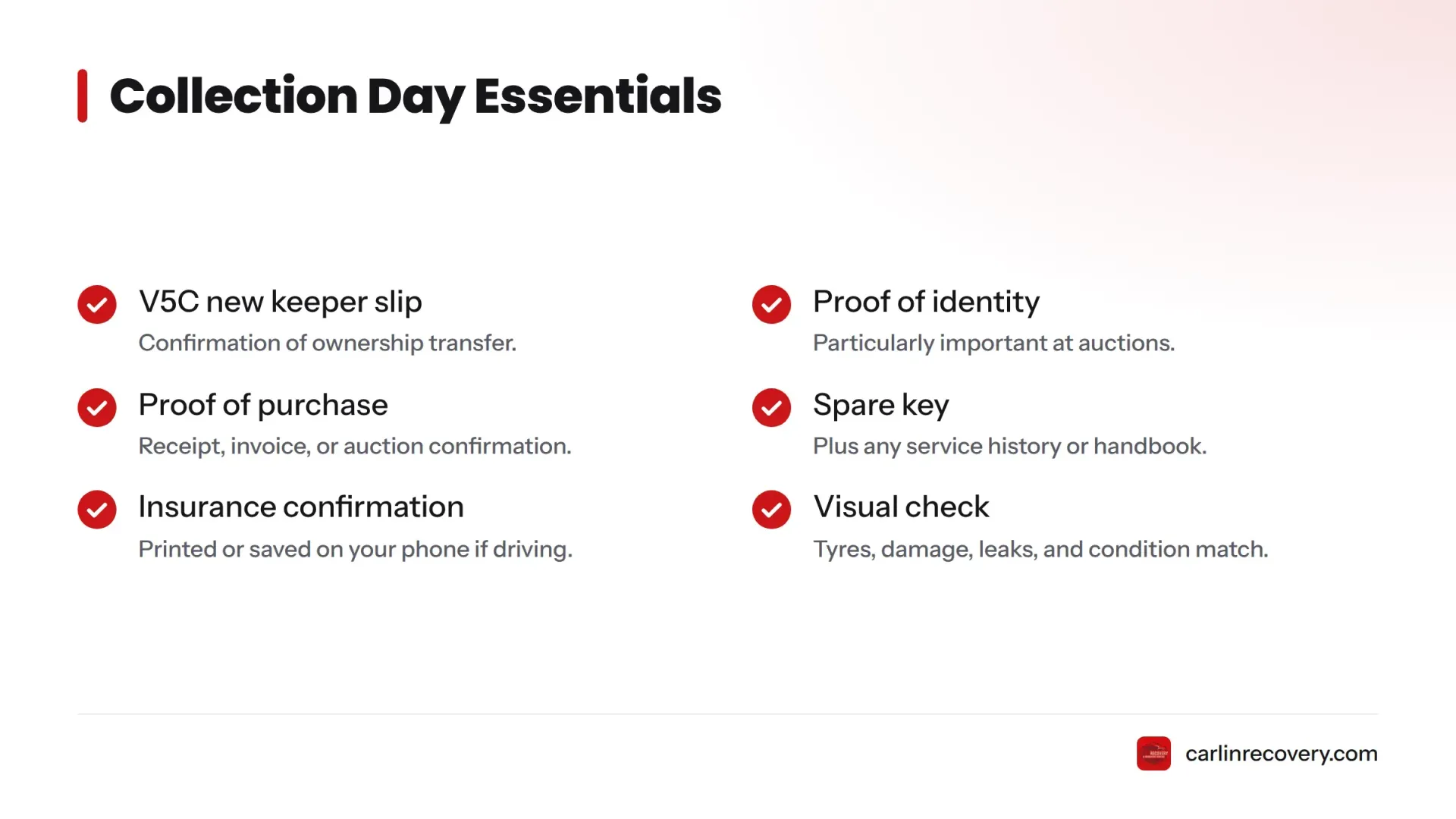
- V5C new keeper slip or confirmation of ownership transfer.
- Proof of identity , particularly important at auctions where you need to prove you're the registered buyer.
- Proof of purchase (receipt, invoice, auction confirmation).
- Spare key if the seller has one, plus any service history or handbook.
- Insurance confirmation if you're driving, printed or saved on your phone.
- Visual check of the car before it moves: tyres, obvious damage, fluid leaks, and that it matches what you were told.
If you're having the car collected, be there or have someone represent you at handover. There's no dispute later about the car's condition when it left.
Step 6: Confirm Safe Delivery
The job isn't done until the car's safely off the trailer and where you want it.
When the car arrives, take a few minutes before signing anything off:
- Walk round and check for any damage picked up in transit.
- Confirm all paperwork, keys and documents have arrived with it.
- Check it's parked somewhere safe and accessible, not blocking your road or a neighbour's drive.
A vehicle collection service can usually deliver straight to your garage instead of your home, if that's where you want the work done or the car stored. Just confirm that drop-off point when you book, not on the day.
The Checklist
Print this off or screenshot it before collection day:
- Confirmed the collection time, location, and who's handing the car over.
- Checked the car's MOT and tax status online before travelling.
- Decided whether I'm driving it home or booking a trailer or flatbed.
- Booked transport in good time, especially for auction collection windows.
- Got the V5C new keeper slip, proof of purchase, and ID sorted.
- Checked the car over before it moved, and again when it arrived.
- Confirmed delivery to the right address, home or garage.
Nothing complicated. Just done in the right order so nothing gets missed.
Frequently Asked Questions
What should I arrange before collecting a car I've just bought?
Confirm the collection time and place with the seller or auction, check the car has valid MOT and tax if you plan to drive it, decide whether you're driving it or booking transport, and get your paperwork ready, including the V5C new keeper slip.
Can I drive a car home without insurance?
No. You need valid insurance before you drive any car on a public road, including one you've just bought. Some personal policies extend limited cover to a newly purchased vehicle, but check with your insurer before assuming it applies.
Do I need to tax a car before driving it home after buying it?
Yes. A car must be taxed before it's driven on a public road. You can check a vehicle's tax status for free using the GOV.UK vehicle tax checker before you arrange how you'll get it home.
What happens if the car doesn't have a valid MOT?
You can't legally drive it on the road, except when driving directly to a pre-booked MOT test. Otherwise you'll need transport, such as a trailer or flatbed.
Can I collect a car from an auction myself?
Yes, many buyers do. Check the auction's collection window, bring the right ID and proof of purchase, and confirm beforehand whether the car has valid MOT and tax. If it isn't road legal, book transport.
What's the difference between driving a car home and booking transport?
Driving means the car must be road-ready with valid MOT, tax and insurance cover, and you need to be confident in its condition. Booking transport means the car is carried on a trailer or flatbed and never driven on the road until it reaches you. That works for non-runners, untaxed vehicles, or ones you don't yet know well enough to trust on a long drive.
When should I book a flatbed or trailer instead of driving myself?
Book transport if the car isn't taxed or MOT'd, if it's a non-runner, if you bought it at auction without test-driving it, or if you don't have insurance cover yet. If there's any doubt, transport is the safer call.
What paperwork do I need on collection day?
Bring your ID, proof of purchase, and collect the V5C new keeper slip from the seller along with any spare keys or service history. If you're driving the car yourself, also have proof of insurance ready.
Do I need the full V5C logbook before I can drive away?
You don't need the full V5C reissued in your name before driving, but you should always get the green new keeper slip from the seller at handover. It's your proof of the sale and the seller's responsibility to notify the vehicle licensing authority of the change.
How do I confirm collection details with a private seller?
Agree the exact address, a realistic time window, and confirm who'll be present with the keys and paperwork, ideally the day before collection. A quick phone call avoids wasted journeys.
Is it legal to move an untaxed vehicle on a trailer?
A vehicle carried on a trailer or recovery truck is treated differently to one driven under its own power. This is exactly why transport services exist for cars that can't legally be driven. For specific legal requirements around vehicle tax and movement, check the official nidirect guidance on vehicle tax for Northern Ireland registered vehicles.
What does a pre-booked vehicle collection service include?
It covers agreeing pickup and drop-off locations, loading the vehicle securely onto a trailer or flatbed, transporting it safely, and handling the paperwork at both ends so you're not managing two locations yourself.
How far will a vehicle collection service travel?
This varies by provider. I generally work within around 60 miles of Ballymena for vehicle transportation across Northern Ireland, but always confirm a specific job before committing, particularly if the collection point is further afield.
What should I check on the car before it's loaded?
Check the tyres, look for obvious damage or fluid leaks, confirm the mileage matches what you were told, and make sure it matches the description from the sale. Take a few photos at this point too, in case anything's disputed later.
How is a car loaded and unloaded safely?
The vehicle is driven or winched onto the trailer or flatbed, then secured with straps or chains at multiple points so it can't shift during the journey. On arrival, it's released from those restraints and driven or lowered off in a controlled way.
What should I check when the car is delivered?
Walk round the car for any new damage, confirm all paperwork and keys have arrived with it, and check it's parked somewhere safe and accessible before you sign off.
Can a collection service deliver to my garage instead of home?
Yes, most can deliver to whichever address suits you, home or garage, as long as you confirm that drop-off point when you book.
What should I do if I can't collect the car myself on the agreed day?
Book a transport provider to collect on your behalf, or arrange for someone you trust to attend with your authorisation and the agreed paperwork.
Is it safer to have a professional collect from a stranger or auction?
It takes the uncertainty out of driving an unknown vehicle, especially one you haven't test-driven or one with no MOT. For auction purchases in particular, professional collection avoids the pressure of auction storage deadlines and the risk of driving something you don't yet know is roadworthy.
What identification do I need on collection day?
Bring a form of photo ID and your proof of purchase (receipt, invoice, or auction confirmation). Auction sites will usually verify you're the registered buyer before releasing the vehicle.
How do I know if a car is roadworthy enough to drive home?
Check it has valid MOT and tax, then give it a visual once-over for tyre condition, fluid leaks, and warning lights. If you've got any doubt at all about whether it'll make the journey safely, book transport instead.
Moving a car you've just bought doesn't need to be stressful. Confirm the details, check the legal status, make the drive-or-transport call early, and have your paperwork sorted. Get those four things right and the rest falls into place on its own.