Breaking down is stressful enough without wondering if the person you've called will actually show up. Before you pick a recovery company, there are six things worth checking: are they genuinely local, how quickly can they reach you, who actually turns up at the roadside, what do their reviews really say, does their equipment suit your vehicle, and will they keep you updated while you wait.
I'm Danny Crangle, and I run Carlin Recovery out of Ballymena. I've answered enough breakdown calls to know what separates a recovery company that gets it right from one that leaves you standing on a hard shoulder wondering what's happening. This isn't a generic list. It's what I'd tell a mate if they asked me how to pick someone they can trust before they ever need one.
Six Checks That Actually Matter
There's a lot of noise when you search for a breakdown service Northern Ireland drivers can rely on. Some of what comes up is a genuine local recovery operator. Some of it is a call centre with a nice website and no vehicles of its own. Run through these checks in order, and you'll know within a couple of minutes on the phone which one you're dealing with before you hand over your location and card details.
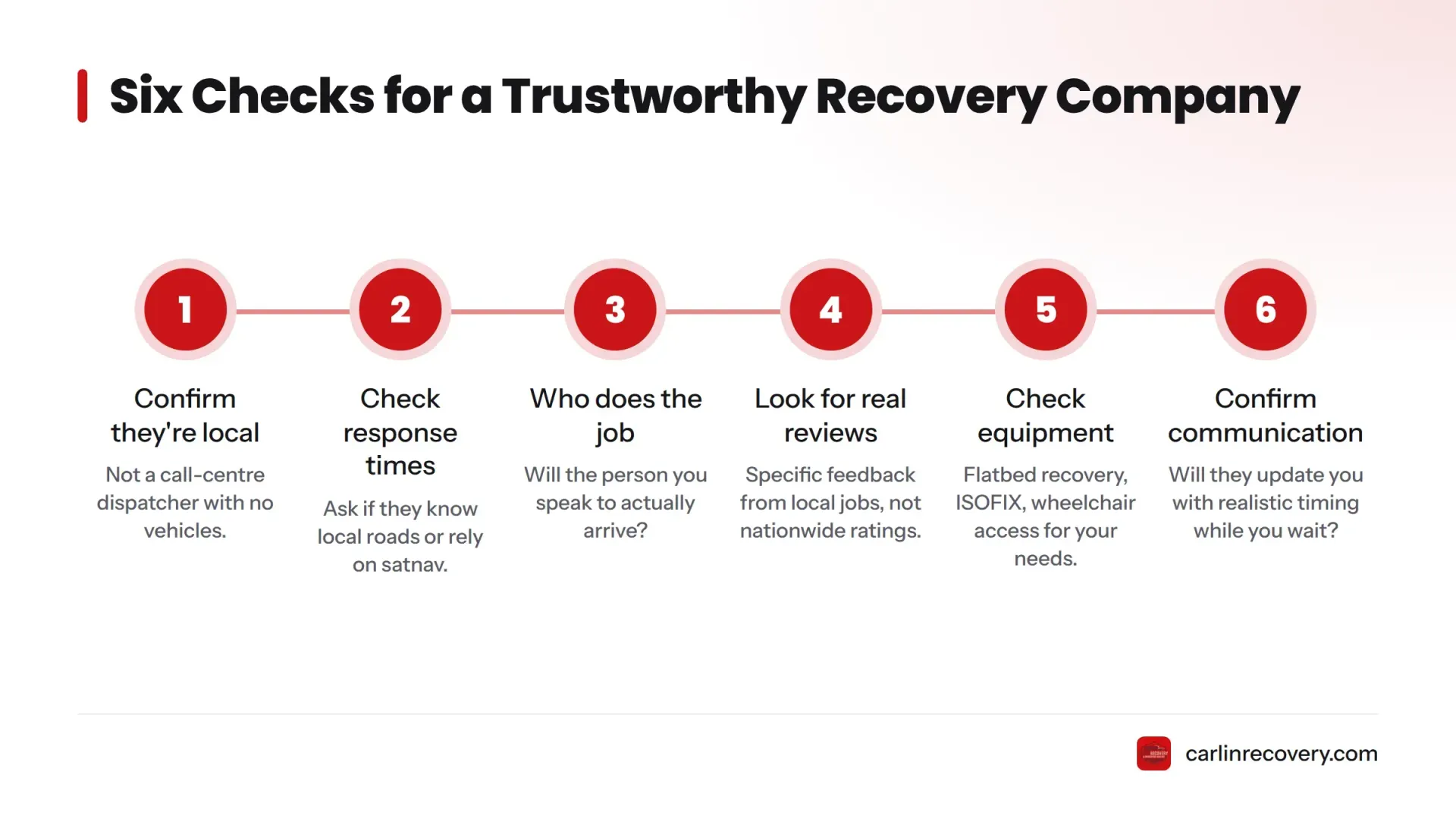
- Confirm they're local, not a call-centre dispatcher.
- Check their response times and how well they know the local roads.
- Ask who actually turns up to do the job.
- Look for real reviews and a local reputation.
- Check their equipment suits your vehicle and your situation.
- Ask how they'll communicate with you while you wait.
Get through those in sequence and you'll know whether you're talking to someone who'll genuinely help or someone about to pass your job down a chain you can't see.
Step 1: Local vs Call Centre - Why It Matters
A recovery company actually based near you knows the roads, knows the difficult junctions, and has a vehicle sitting close by rather than being dispatched from wherever the next available driver happens to be. When I pick up the phone, I know roughly where you are before you've finished speaking, because I drive these roads every day. That's something a national dispatch network can't replicate, no matter how good their software is.
A call-centre dispatcher answers calls on behalf of a wider network, then passes your job to whichever subcontractor recovery driver is free and willing to take it. There's nothing inherently wrong with that model, but you should know which one you're calling.
A few tells that give it away:
- If you ask "are you the one coming out to me?" and they can't answer directly, you're through to a dispatcher, not the driver.
- A genuine local operator can usually describe their own recovery vehicle without checking with someone else.
- National numbers often read from a script and ask for your postcode to "find your nearest provider" rather than confirming they already cover your area.
Step 2: Response Times and Road Knowledge
Response time isn't just about how many vehicles a network has. It's about whether the person reaching you actually knows the quickest way there, including the back roads, farm lanes and bits of County Antrim that don't show up neatly on satnav. I cover roughly 60 miles out from Ballymena, and that local knowledge often saves real time compared with someone following a screen and guessing at junctions they've never driven.
Ask this on the phone: "Do you know this road, or will you be following satnav the whole way?" A local operator will usually know straight away. A dispatcher won't, because they're not the one driving.
Before you book, also ask:
- How far out do you actually cover?
- Is there a vehicle near me right now, or will one be sent from further away?
- Will the same person I'm speaking to be the one who arrives?
Step 3: Owner-Operator vs Subcontractor
An owner-operator owns their own recovery vehicle, runs their own business, and does the work themselves. That matters because if something goes wrong, or you have a question about your vehicle after it's been collected, there's one person who knows exactly what happened and is accountable for it. With a subcontractor working through a national dispatch network, your vehicle might be handled by someone the parent company has never met, booked through an app, with no ongoing relationship to either you or the firm whose name was advertised.
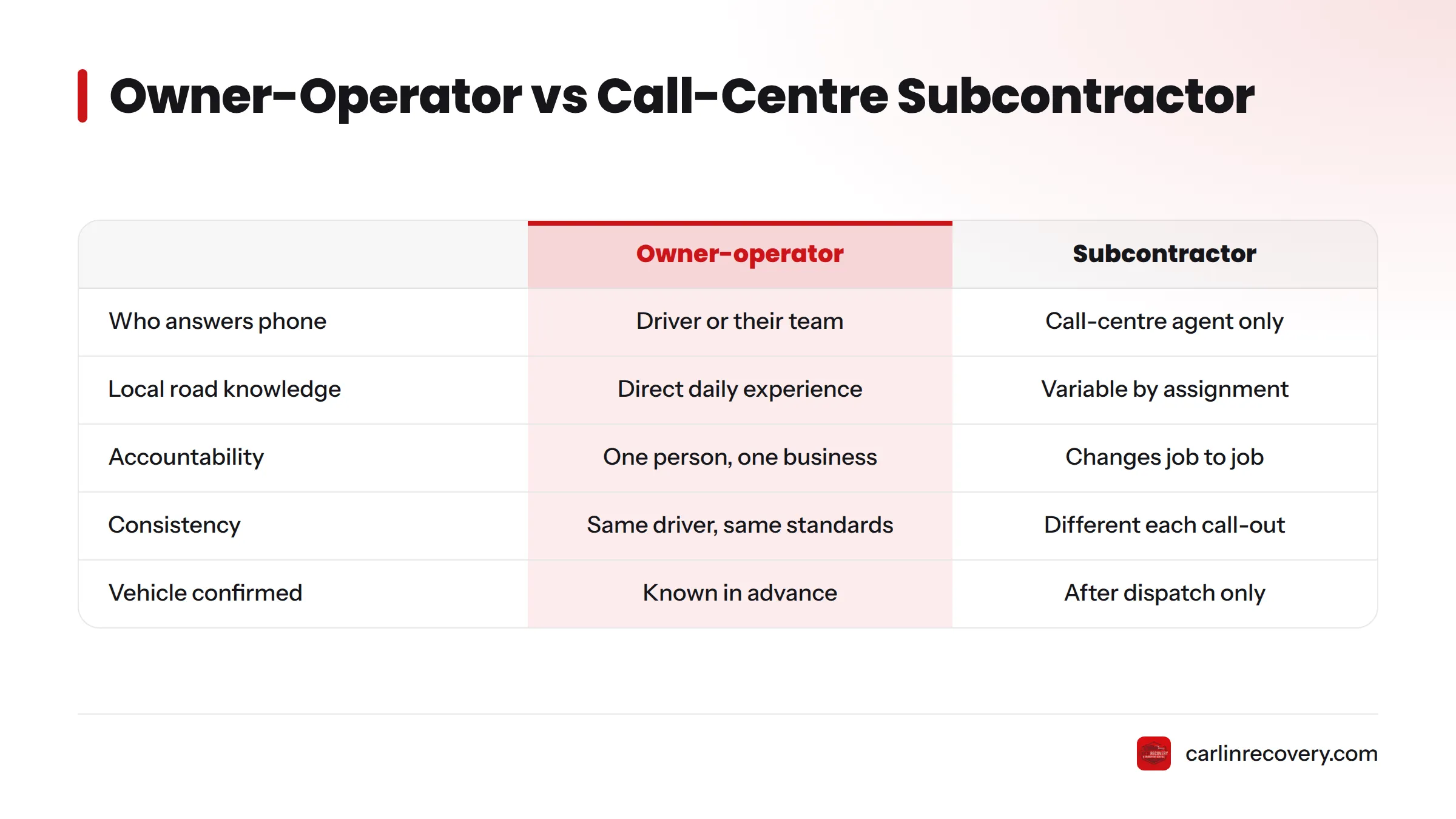
Here's what the difference looks like in practice:
| Local owner-operator | Call-centre-dispatched subcontractor | |
|---|---|---|
| Who answers the phone | The person doing the job, or someone who works directly with them | A call-centre agent with no vehicle of their own |
| Local road knowledge | Direct, from driving the area daily | Variable, depends who's been sent |
| Accountability | One person, one business, one point of contact | Can change job to job |
| Consistency | Same driver, same standards each time | Different subcontractor each call-out |
| Vehicle suitability | Known in advance by the person you spoke to | Often confirmed after dispatch, not before |
Step 4: Real Reviews From People Like You
Big national providers' reviews get buried under thousands of entries from all over the country, and you can't tell if any of them are about the person who'd actually be sent to you. A local recovery operator's reviews usually come from people in your own area, sometimes people you might even know. They mention specifics: how quickly someone arrived, how the vehicle was handled, whether someone explained what was happening. That's worth more than a star rating on its own.
When you're checking a recovery company, ask to see reviews from jobs in your local area. You can see what people in and around Ballymena have said about our work on our Carlin Recovery reviews page, which I'd encourage you to check against any recovery company you're considering, including us.
Step 5: The Right Equipment for Your Vehicle
Not every recovery job is the same, and not every recovery vehicle is set up for every situation. Flatbed recovery NI carries your vehicle fully off the ground rather than towing it on its wheels, which matters for anything with a damaged axle, a non-runner, or a car you simply don't want racking up extra wear. Towing pulls the vehicle behind on its own wheels, which works fine for some straightforward breakdowns but not all.
Before you book, ask:
- Can you handle a flatbed recovery if that's what's needed?
- If I've got passengers, including children who need ISOFIX seats, can you take them safely?
- Can you assist a wheelchair user during the recovery?
A genuine local operator should answer these without hesitation, because they know their own vehicle and what it can do. You can read more about what our setup covers on our vehicle recovery Ballymena page.
Step 6: Communication While You Wait
Standing at the side of the road not knowing if anyone's actually coming is one of the worst parts of breaking down. A recovery company worth choosing will give you a realistic idea of timing, tell you if anything changes, and let you know when the driver is close. If you're told "someone will be with you soon" with no actual estimate, or you can't get anyone back on the phone once you've booked, that's a sign you're dealing with a dispatcher managing a queue rather than someone personally responsible for getting to you.
If you're waiting roadside, follow basic safety advice. The UK Government's guidance on what to do if your vehicle breaks down covers where to stand, how to stay visible, and when to call for emergency help rather than a recovery company.
Final Checklist
Run through this in under a minute before you book anyone:
- Are they local, with their own vehicle, or a call-centre passing work to a subcontractor?
- Do they know the roads in your area, or are they relying entirely on satnav?
- Will the person you're speaking to be the one who actually arrives?
- Do their reviews mention real, specific local jobs?
- Can they confirm the right equipment for your vehicle, including flatbed recovery, ISOFIX or accessibility needs?
- Will they keep you updated if anything changes while you wait?
If you can tick most of these before you hang up, you've likely found a recovery company you can trust.
Here's a video from someone actually running a recovery business covering similar ground from the operator's side - worth a watch if you want to understand how these decisions get made from behind the wheel:
Frequently Asked Questions
How do I know if a recovery company is actually local or just a call-centre number?
Ask them directly whether the person you're speaking to will be the one coming out to you, and ask what vehicle they'll be sending. A genuine local operator answers both without needing to check with anyone else.
Why does it matter if a recovery driver is an owner-operator rather than a subcontractor?
An owner-operator is personally accountable for the job from start to finish, with consistent standards each time. A subcontractor dispatched through a national network can change from call to call, with no ongoing relationship to you or the company whose name was advertised.
What's the difference between flatbed recovery and towing?
Flatbed recovery carries your vehicle fully off the road on a platform, which suits non-runners, accident-damaged vehicles, and anything with axle or transmission issues. Towing pulls the vehicle along on its own wheels, which works for some straightforward breakdowns but not all.
Can a recovery company handle a vehicle with passengers, including children needing ISOFIX seats, or assist a wheelchair user?
It depends on the operator's vehicle and setup, so ask directly before booking. Don't assume every recovery vehicle is equipped the same way.
What areas does a typical local recovery company in Northern Ireland cover?
This varies by operator. We cover roughly 60 miles out from Ballymena across County Antrim and beyond, but always confirm coverage for your specific location before you book, since not every local firm covers the same radius.
Is it better to call a local recovery firm directly or go through a call centre?
Calling a local recovery operator directly generally means faster, clearer communication and a known, accountable driver. A call centre adds a layer between you and whoever actually arrives, which can mean longer waits and less certainty about who's coming.
If cost is part of your decision, that's worth talking about separately rather than squeezing it in here. For now, the six checks above put you ahead of most people who ring the first number they find. You can also find out more about how we work at Carlin Recovery directly, or get in touch if you'd like to talk through what you need before you're ever stuck at the side of the road.