Let's sort out something that confuses a lot of people when they're getting rid of an old car. "Scrap it" and "sell it for cash" get thrown around like they mean the same thing, but they don't. Scrapping ends a vehicle's life through a licensed facility, with payment based on weight and metal content. Selling for cash means someone buys the car as it stands - running or not - because there's still value to extract: parts, a repair job, or a straight resale. One almost always pays less. The other almost always pays more, but only if your car still has something left to offer.
I'm Danny Crangle, and I run Carlin Recovery out of Ballymena. Between recovery jobs, breakdowns, and buying and selling used cars across Northern Ireland, I see this exact decision land on someone's lap most weeks. Let me walk you through it properly, no jargon, no messing about.
What Scrapping a Car Actually Means
When you scrap a car, that vehicle reaches the end of the road for good. It's classed as an end-of-life vehicle, or ELV, and it gets processed at a licensed site rather than sold on to another driver. The whole car gets taken apart, usable metal gets recovered, and everything else is handled according to environmental rules.
Once that happens, the car is finished as a road-going vehicle. You get a Certificate of Destruction from the facility, and the DVLA is notified that the vehicle no longer exists on the road. That's a one-way door. There's no coming back from a Certificate of Destruction, so it only makes sense when a car genuinely has nothing left worth saving - mechanically or financially.
The payout for scrapping is based on what's inside the car, not what it looks like. Weight, metal content, and what the facility can recover drive the figure, not how clean the interior is or how many miles are on the clock.
What Selling for Cash Actually Means
Selling for cash is a different deal entirely. Someone buys your vehicle as it is - running or sitting dead on the drive - because there's still value to be had from it. That value might come from parts still in demand, a repair that puts the car back on the road, or a straight resale to someone who just needs cheap, usable transport.
The car doesn't get destroyed. It might get fixed up and sold on, broken for parts that still work, or passed along to someone who sees potential you don't. That's the key thing: a cash sale keeps options open for the vehicle, while scrapping closes them for good.
If you're trying to move a vehicle this way, it helps to know what buyers are actually looking for. I've covered the practical side on the Carlin Recovery site, including how to go about it when a car won't start, through our page on selling your vehicle for free collection across Northern Ireland.
Scrap Value vs Cash-Buy Value: What Actually Matters
This is where most people get caught out, because they assume one number applies across the board. It doesn't. Scrap value and cash-buy value are worked out on completely different logic.
Scrap value comes down to weight and metal content, plus whatever recoverable material the facility can pull from the car. Condition barely matters here. A non-runner with a blown engine scraps for roughly the same as a non-runner with a tidy engine, because neither is going back on the road as a whole unit.
Cash-buy value depends on the opposite things: condition, what parts are in demand, whether the car could be repaired and resold, and whether it still holds an MOT or could pass one without much work. A runner with a recent MOT and decent bodywork is worth a lot more sold for cash than it would ever fetch scrapped, because somebody can actually use it.
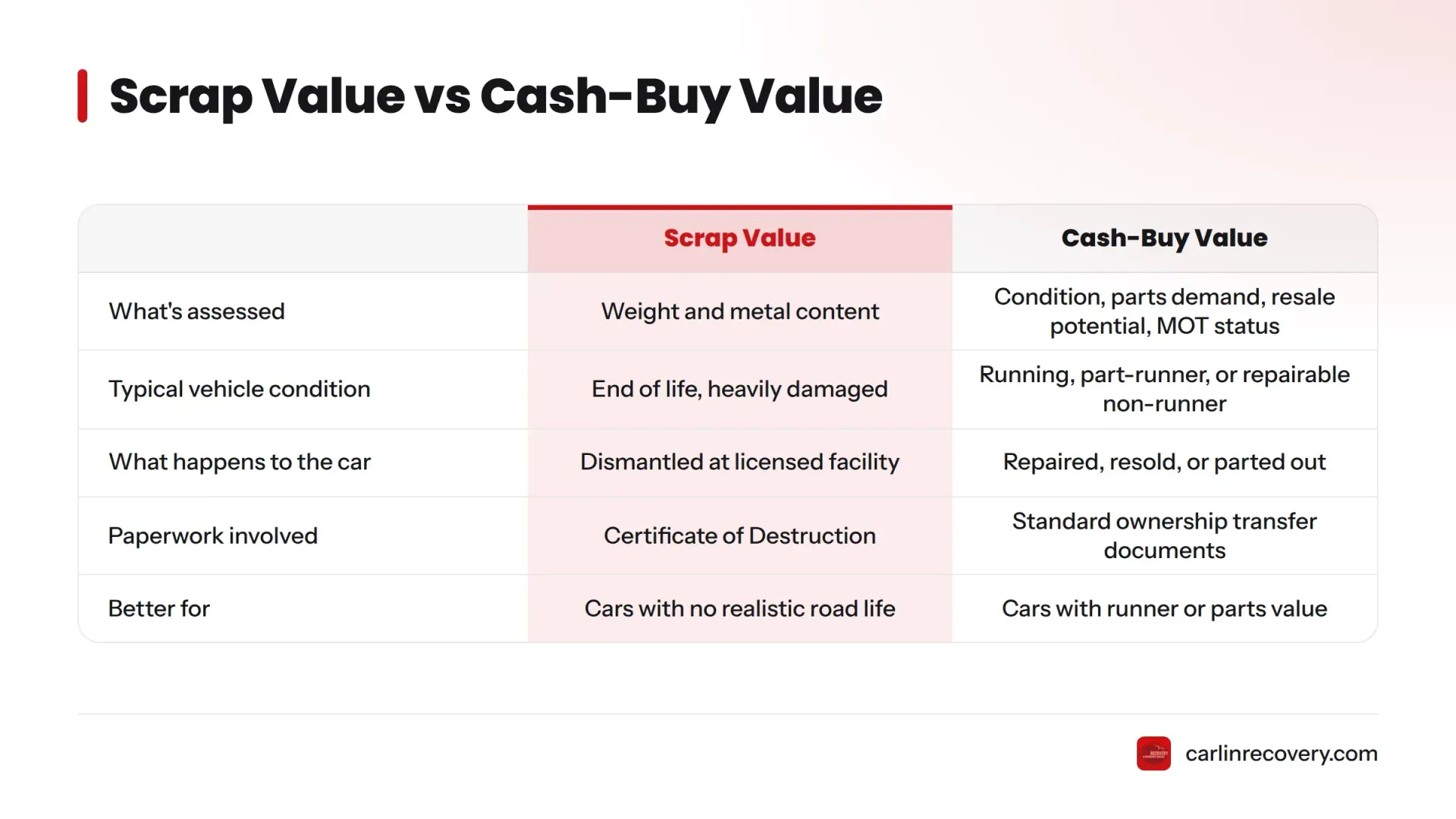
Here's how they stack up side by side:
| Scrap Value | Cash-Buy Value | |
|---|---|---|
| What's assessed | Weight and metal content | Condition, parts demand, resale potential, MOT status |
| Typical vehicle condition | End of life, heavily damaged, uneconomical to repair | Running, part-runner, or repairable non-runner |
| What happens to the car | Dismantled and processed at a licensed facility | Repaired, resold, or parted out |
| Paperwork involved | Certificate of Destruction, DVLA notified | Standard ownership transfer documents |
| Better for | Cars with no realistic road life left | Cars with some runner, repair, or parts value remaining |
Neither route is "better" in the abstract. It depends entirely on what's actually left in your particular car.
Real Vehicles, Real Outcomes
I'll give you the honest version rather than a sales pitch, because that's the only way this is actually useful.
When a vehicle turns up with a seized engine, no MOT, and bodywork that's been sitting out for a few winters, there's not much argument to be had. That one is going the scrap route, because the realistic outcome is the same: there's no road life left in it, and the value is in what comes out of it once it's broken down.
Compare that to a car that's a non-runner only because the battery's flat or there's a straightforward fault, still holds a recent MOT, or has panels and an interior in decent nick. That's a different conversation. That one often makes more sense as a cash sale, because somebody - whether that's me or another buyer - can see a repair job or resale worth more than the metal alone.
I look at the same handful of things every time: does it run or nearly run, what's the MOT status, how's the bodywork, and is there an obvious fault stopping it rather than the whole car being worn out. Those answers tell you which route actually makes sense. I'm not going to pretend every car gets bought outright, because it doesn't. Some genuinely are only fit for scrap, and I'll tell you that straight rather than string you along.
Condition and Paperwork: What Each Route Requires
The paperwork side is where people get caught out, so it's worth knowing the basics before you commit to either route.
If you scrap the car:
- The facility handling it should be licensed to issue a Certificate of Destruction once the vehicle is processed.
- The DVLA needs to be told the vehicle has been scrapped, which legally ends your responsibility for it. You can find the official process directly through GOV.UK's guidance on telling DVLA you've scrapped your vehicle.
- Keep that Certificate of Destruction. It's your proof the car no longer exists and you're no longer liable for it.
If you sell the car for cash:
- You'll still need standard ownership documents, the V5C logbook being the main one, so the sale can be registered correctly.
- There's no Certificate of Destruction involved, because the car isn't being destroyed.
- If the vehicle has been through an insurance write-off, it may carry a write-off category marker. That affects its salvage value and what a buyer can legally do with it afterwards, so it's worth knowing which category applies before you sell.
A quick word on terms that get mixed up a lot. Salvage value usually refers to what a damaged or written-off vehicle is worth for parts or repair, which is a cash-sale concept. Scrap value refers strictly to the metal and material recovery figure. They're related but not interchangeable, and knowing which one applies to your car saves confusion when you're talking to a buyer.
Which Route Suits Which Vehicle
Keep this simple, because it usually is once you're honest about the car's actual condition.
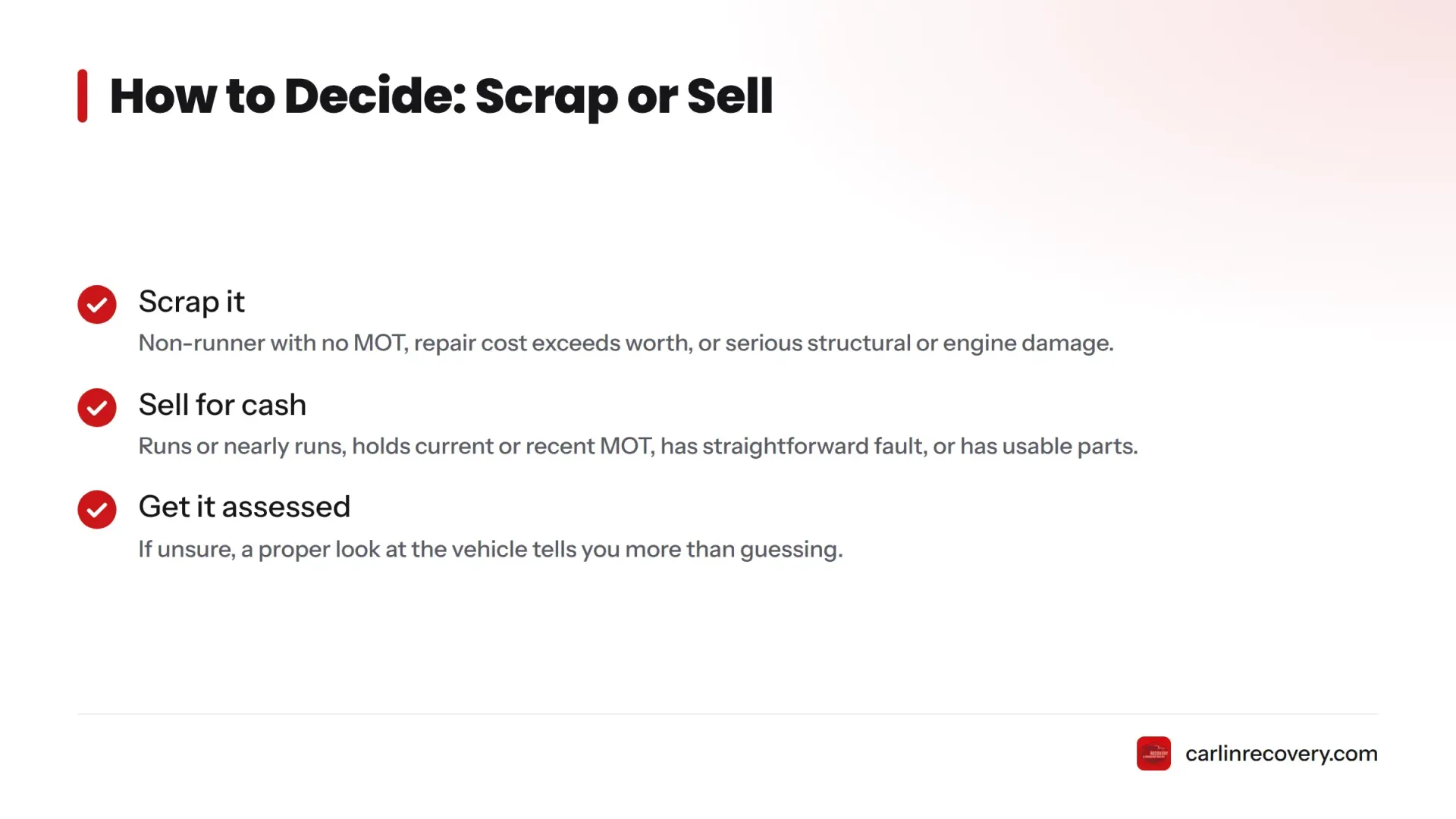
- Scrap it if the car is a non-runner with no MOT, the repair cost would outweigh the car's worth, or there's serious structural or engine damage with no realistic road future.
- Sell for cash if the car runs or nearly runs, holds a current or recent MOT, has a straightforward fault rather than total failure, or still has usable parts and decent bodywork.
- Get it assessed either way if you're genuinely not sure. A quick look at the vehicle tells you more than guessing ever will.
If your car won't start and you're not sure which category it falls into, that's common enough that it deserves a proper walkthrough rather than a few lines here. I'd point you toward getting that vehicle properly assessed through Carlin Recovery's free collection service rather than guessing at home.
This video does a fair job of walking through the thinking from the seller's side, weighing up scrapping against selling for parts:
Scrap or Sell: The Quick Answer
Scrap your car when it genuinely has no road life or repair value left, and you want a clean, final end with a Certificate of Destruction and the DVLA notified. Sell it for cash when there's still something worth having - a runner, a fixable fault, or parts still in demand - because that route almost always pays more than scrap value alone.
Frequently Asked Questions
Do you get more money scrapping a car or selling it? Selling for cash usually pays more, but only when the car still has runner, repair, or parts value. If it genuinely has none of that, scrap value and cash-buy value end up close together, or scrapping becomes the only realistic option.
What is a Certificate of Destruction and do I need one? It's the document a licensed facility issues once your car has been processed as scrap, confirming it no longer exists as a road vehicle. You need one any time a car is scrapped, as it's your proof you're no longer responsible for it.
Do I need to notify the DVLA if I scrap my car? Yes. Once a vehicle is scrapped, the DVLA needs to know so your name comes off the record for that vehicle. You can check the exact steps on GOV.UK.
Does a non-runner have to be scrapped? No. Plenty of non-runners are sold for cash rather than scrapped, especially if the fault is minor, the car still holds an MOT, or it's recent enough to have good parts or resale demand. Scrap is only the right call when there's genuinely nothing left to save.
What's the difference between salvage value and scrap value? Salvage value relates to what a damaged or written-off car is worth for repair or parts, which sits under the cash-sale side of things. Scrap value is strictly the metal and material recovery figure from a licensed facility. They're calculated differently and rarely land on the same number.
What does "write-off category" mean for my car? It's the classification an insurer gives a vehicle after an accident, based on how severe the damage is and whether it's economical to repair. The category affects what can legally be done with the car afterwards and plays directly into its salvage value if you choose to sell rather than scrap.
Next Steps
If you're staring at a car on your drive wondering which way to go, be honest about its condition first. Does it run? Does it have an MOT? Is the fault something fixable or something terminal? Those answers point you to scrap or cash before you ever need to speak to anyone.
And if you'd rather just have someone take a proper look, that's what I'm here for. I'll tell you straight which route your car actually fits, with free collection included across Northern Ireland, through Carlin Recovery.
Sources
Related: sell your car Northern Ireland