Your car breaks down on a County Antrim road. First, if it still has power, get it off the tarmac. Switch hazards on immediately. Get yourself and anyone with you out and away from traffic. Then call for recovery. Everything else comes after those four things.
I'm Danny Crangle, and I've spent years pulling cars off rural roads and dual carriageways around Ballymena. Let me walk you through exactly what happens, in the order that keeps you safest.
Step 1: Get Off the Road Safely
The moment your car stops, your only job is moving it away from moving traffic. Don't worry about what's wrong with the engine yet. That can wait. Getting out of the path of oncoming vehicles can't.
On a dual carriageway or road with a hard shoulder
Indicate, slow down gradually, and steer onto the hard shoulder as far left as you can, ideally near a marker post or past a bridge if one's close. A hard shoulder is the paved strip running along the edge of a carriageway, kept clear for exactly this situation. Get your wheels right up against the verge or barrier, angling the car slightly away from the driving lane if there's room. Before you get out, turn the steering wheel away from traffic. If the car gets struck, it'll be pushed further from the road, not back into it.
On a narrow rural road with no hard shoulder
Most of County Antrim's driving happens on narrow rural roads with no hard shoulder at all - just a grass verge, a hedge, or nothing but a ditch. Get as far onto the verge as possible, even if that means two wheels on the grass. On the back roads round the Braid Valley or off the main Ballymena routes, there's often barely any room to work with. If there's a field entrance, a wider gateway, or a layby within reach, aim for that rather than stopping on a blind bend. Never leave your car sitting fully in the lane on a narrow road if you can nudge it forward even a few feet.
Step 2: Switch On Hazard Lights and Stay Visible
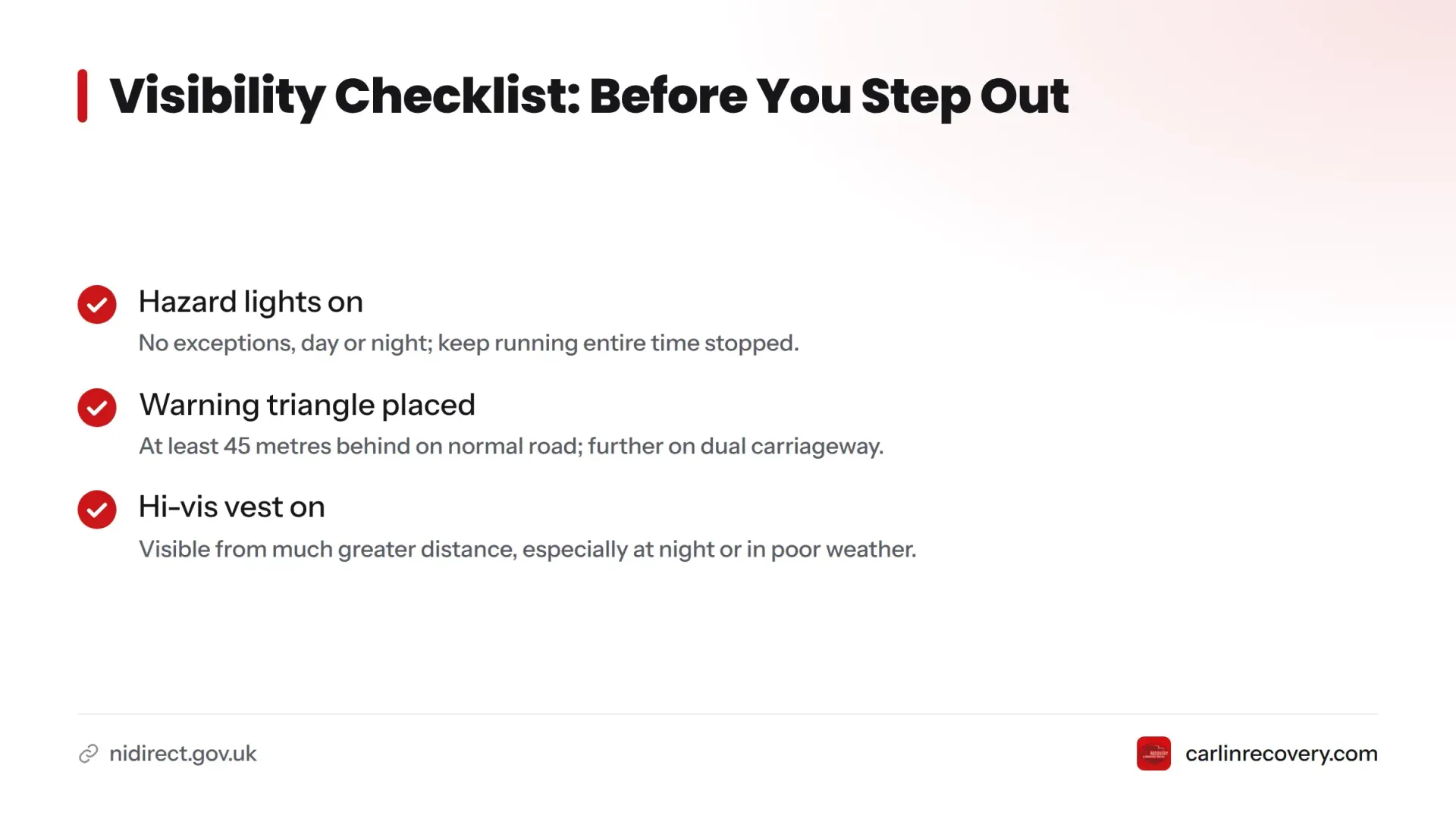
The moment the car stops, hazard lights go on. No exceptions, day or night. Hazard lights are the four indicators flashing together, and they tell every approaching driver that something's wrong and they need to slow down and give you space. Keep them running the whole time you're stopped, even if you're worried about draining the battery. Visibility matters far more.
Using a warning triangle
If you're carrying a warning triangle, place it at least 45 metres behind your vehicle on a normal road, further back on a fast dual carriageway, so approaching traffic has time to react. Only walk out to place it if you can do so safely, well away from the live lane, and never try it on a fast road or in poor visibility. According to nidirect's Highway Code guidance on vehicle breakdowns and incidents, a warning triangle helps alert other traffic, but it should never be used on a motorway. There's no strict legal requirement to carry one in Northern Ireland, but having it ready can make a real difference to how quickly other drivers see you.
Why a hi-vis vest makes a difference
A high-visibility vest takes two seconds to put on and makes you visible from a much greater distance, especially at night, in rain, or on an unlit road - which describes a lot of County Antrim after dark. Keep one in the glovebox or door pocket, not buried in the boot, so you can put it on before stepping out. If you've got more than one passenger, keep a couple of vests in the car so everyone getting out is visible.
Step 3: Get Out and Move Away From Traffic
Once hazards are on and you're as visible as you can be, the next priority is getting people out of harm's way. A stationary car on the road is a hazard. A person standing beside it is a far bigger one.
Exiting safely on busy roads
Check your mirrors and look behind before anyone opens a door. On a dual carriageway or any fast road, everyone should exit from the passenger side away from traffic if possible, then move well back from the vehicle - behind a barrier or onto the verge, not just a step or two from the car. Don't stand between your vehicle and oncoming traffic, and don't linger at the boot sorting bags or shopping. Get people clear first.
Keeping children safe
Get children out and hold hands walking to a safe spot well off the road, away from the hard shoulder or verge edge, ideally behind a barrier or up a bank. Don't let them wander back toward the car for toys or bags. If it's cold, wet, or dark, a coat and the hi-vis vest matter more than comfort right now. Keep everyone together in one place rather than spread out along the verge.
Step 4: Call for Breakdown Recovery
Once everyone's safely clear of the road, get help on the way. This is where you call for 24-hour roadside recovery rather than attempting anything yourself at the roadside. I'd always rather talk you through getting safe and get a vehicle out to you than have you standing in a live lane trying to fix something.
What information to have ready
Before you dial, have these basics ready so the call is quick and the right help gets sent:
- Your exact location: nearest town, road name or number, and any landmark you can see (a junction, a bridge, a farm gate)
- Which direction you're facing and whether you're on a hard shoulder, verge, or layby
- What happened: did the engine cut out, is there smoke, a warning light, a flat tyre, or did it just stop responding
- How many people are in the car and whether anyone needs particular help getting clear
- Your vehicle registration and make
A clear, calm description of where you are is one of the biggest things you can do to speed things up. A lot of the rural roads round Ballymena don't have obvious landmarks, so even a nearby farm name, pub, or junction number helps enormously.
Step 5: Wait Safely Until Help Arrives
Once the call's made, your job is staying safe until recovery gets to you. This is where people slip up, because adrenaline drops and they start wandering back toward the car, checking under the bonnet, or standing too close to the road.
Where to stand while you wait
Stay well back from the vehicle and well back from the live lane, ideally behind a barrier, on a verge set back from the road edge, or up a bank. If there's genuinely nowhere safe to stand near the car - and this does happen on some of County Antrim's narrower stretches - it's sometimes safer to move further away entirely rather than hover near a vehicle stopped in a live lane. Keep an eye on traffic and keep children close.
When the recovery driver arrives
When a recovery vehicle pulls in, I'll position behind your car with hazards and beacon on, assess the situation, and get your vehicle loaded or towed safely and quickly. Stay where you are, off to the side, until I wave you over. I'll let you know what's happening with your car and the next steps once it's safely loaded.
For a visual walkthrough of these steps, this AAA video covers the core sequence clearly.
What I See Most on County Antrim Roads
After years attending breakdowns across Ballymena and wider County Antrim, patterns come up again and again.
On narrow rural roads, the biggest issue isn't usually the breakdown itself - it's that there's nowhere obvious to pull in. Hedges right up to the tarmac, no verge to speak of, and a blind bend just round the corner. People often stop exactly where the car died rather than nudging it forward to a gateway or wider spot, even when they could.
On dual carriageway stretches like sections of the A26, the risk is speed, not space. There's usually a hard shoulder to use, but traffic passing at speed gives drivers far less reaction time than they expect, especially in the dark or heavy rain. I've seen people stand right at the back of their car sorting the boot while traffic streams past at motorway speeds a few feet away. That's the moment that worries me most - not the breakdown, but what people do after.
At night, visibility drops fast on unlit rural roads, and a car without hazards running, or a driver without a hi-vis vest, can be genuinely hard to spot until you're almost on top of it. Three things solve most of the risk before recovery even arrives: get off the road if you can, light yourself up, and get clear of the vehicle.
When It's an Accident, Not a Breakdown
A breakdown is a mechanical failure - your car losing power, overheating, a flat battery, a tyre issue, or a warning light. If there's been a collision with another vehicle, an object, or a person, that's an accident, and it needs a different response: checking for injuries, exchanging details, and possibly contacting police.
If you're not sure which situation you're in, treat it with the same urgency either way: get safe, get visible, get help. For the accident-specific process, I cover that in detail in the sibling guide on what to do after a crash.
Quick Breakdown Safety Checklist
- Get the car off the road onto a hard shoulder, verge, or wider spot
- Hazards on immediately; warning triangle placed safely behind if you're carrying one
- Hi-vis vest on before anyone steps out
- Everyone out and clear of the vehicle, well back from the road
- Call for recovery with your location, situation, and registration ready
- Wait safely behind a barrier or on the verge until recovery arrives
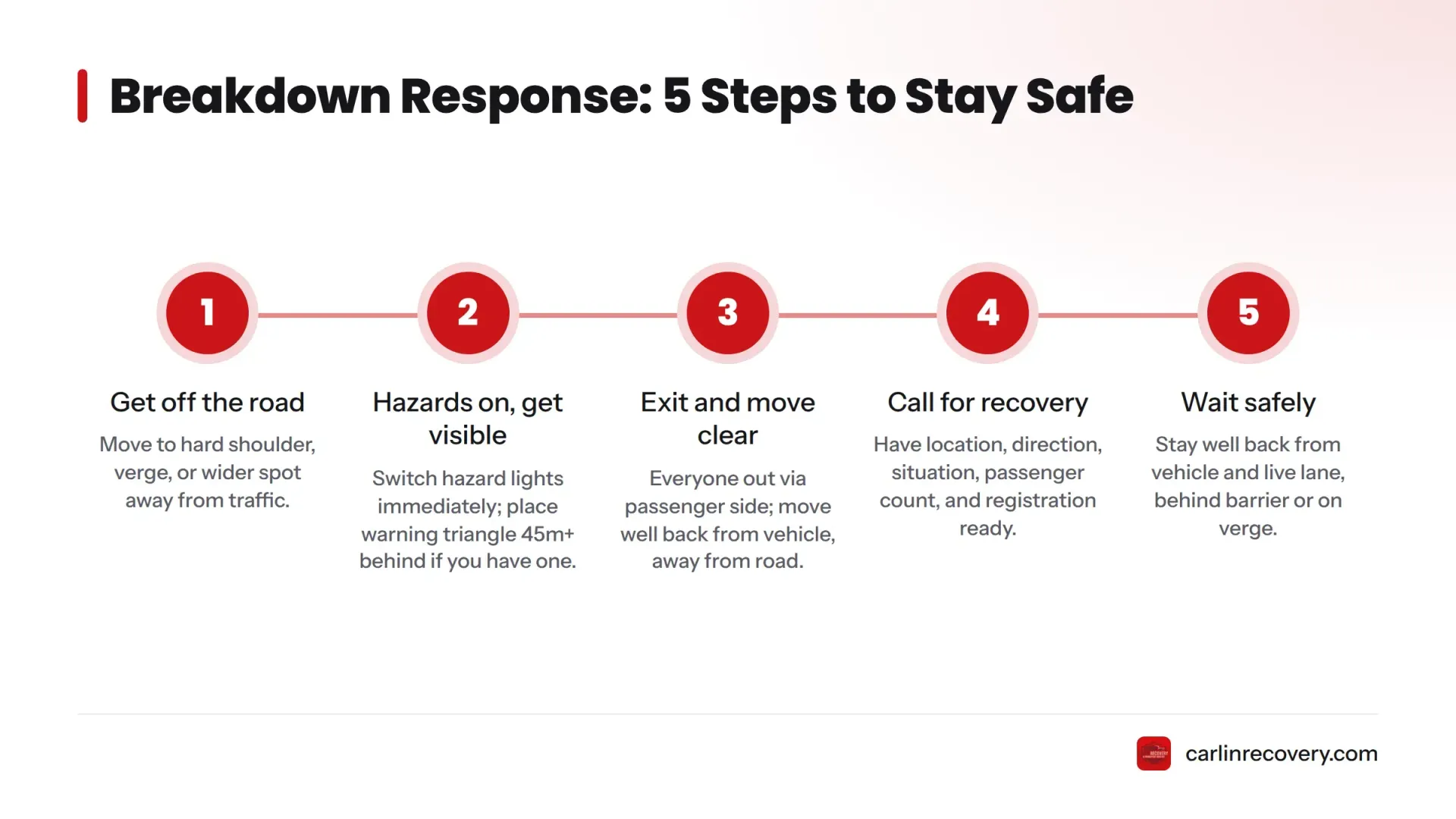
Breaking down is never convenient, and it's rarely calm in the moment. But the order of these steps doesn't change whether you're stuck on a quiet lane outside Ballymena or caught on a dual carriageway. Get off the road, get seen, get clear, get help, then wait safe.
I've built Carlin Recovery around exactly that approach. If you ever need a hand getting your vehicle sorted and moved safely, you can find more about how I can help across County Antrim on the Carlin Recovery homepage.
Frequently Asked Questions
What is the first thing I should do if my car breaks down? Get the car off the live lane onto a hard shoulder, verge, or layby if you can, then switch on your hazard lights immediately.
Is it safe to stay in my car after a breakdown? On a busy road, a dual carriageway, or in poor visibility, it's generally safer to get out and move well away from the vehicle, behind a barrier if there is one. On a quiet, safe rural road with nowhere else to go, staying in the car with the seatbelt on and hazards running may be safer. Use your judgement based on the traffic and road you're on.
What are hazard warning lights and when should I use them? Hazard lights are all four indicators flashing at once. Switch them on the moment your vehicle stops moving because of a breakdown, to warn other drivers to slow down and move around you.
What is a hard shoulder and should I always pull onto one? A hard shoulder is the paved strip at the edge of a dual carriageway kept clear for emergencies and breakdowns. Yes, you should always aim to get onto it if your car has one available and still has enough power to move there.
What do I do if there's no hard shoulder on a rural road? Get as far onto the verge, grass, or any wider section of road as you can, even a field gateway or layby a short distance ahead, rather than leaving the car sitting in the live lane.
Do I need to carry a warning triangle in Northern Ireland? There's no strict legal requirement, but nidirect's guidance on vehicle breakdowns and incidents recommends using a warning triangle to alert other traffic, placed safely well behind your vehicle, and never on a motorway.
Where should I place a warning triangle behind my car? Place it at least 45 metres behind the vehicle on a normal road, further back on a faster dual carriageway, and only walk out to position it if you can do so without stepping into a live lane.
Is it illegal not to use hazard lights during a breakdown? Hazard lights aren't legally compulsory in every breakdown scenario, but using them is standard practice and strongly recommended by Northern Ireland road safety guidance to warn other drivers that your vehicle is stationary.
Should I get my passengers out of the car during a breakdown? On a busy or fast road, yes - get everyone out and well clear of the vehicle, ideally behind a barrier or on a safe verge away from traffic.
Where should I stand while waiting for recovery? Stand well back from both your vehicle and the live lane, behind a barrier or crash barrier if available, keeping children close and away from the road edge.
What should I do if I break down on a dual carriageway? Get onto the hard shoulder as far left as possible, hazards on, everyone out and behind the barrier if there is one, then call for recovery and wait well clear of the vehicle.
How do I know if I've broken down on a dangerous stretch of road? If there's a blind bend, no verge, fast-moving traffic, poor lighting, or limited visibility in either direction, treat it as higher risk and prioritise getting yourself and passengers well clear of the vehicle rather than staying close to it.
Who should I call first after a breakdown? Once you and your passengers are safely off the road, call a recovery service. I handle 24-hour roadside recovery across Ballymena and County Antrim.
What information should I have ready when calling for recovery? Your exact location and any landmarks, which direction you're facing, what happened to the car, how many people are with you, and your vehicle registration.
How long does it usually take for a recovery vehicle to arrive? This depends on your location, time of day, and current demand. It's best to ask directly when you call rather than assume a fixed time.
What should I do with children in the car during a breakdown? Get them out, hold hands, and move them to a safe spot well away from the road and the vehicle, keeping them together in one place until recovery arrives.
Is a hi-vis vest necessary for a roadside breakdown? It's not a legal requirement in every situation, but it makes you significantly easier to see for other drivers, especially at night or in poor weather, so it's well worth keeping one in the car.
What's the difference between a breakdown and an accident? A breakdown is a mechanical failure with no collision involved. An accident involves a collision with another vehicle, object, or person and requires a different response, including checking for injuries and possibly contacting police.
What should I do if my car breaks down at night? Follow the same steps: hazards on, get clear of the vehicle, wear a hi-vis vest if you have one. Take extra care with visibility, since unlit rural roads round County Antrim can make both your car and you hard to spot.
Can I attempt to fix the car myself at the roadside? It's best to avoid working on the vehicle at the roadside, particularly on a verge or hard shoulder next to moving traffic. Getting yourself safe and calling for recovery is the priority over any DIY fix.
What does a breakdown recovery service actually do when it arrives? A recovery vehicle will position safely behind your car, assess the situation, and either tow or load your vehicle to take it to a garage or your chosen destination, while you wait clear of the road.
What are the biggest risks breaking down on County Antrim rural roads? Narrow verges, blind bends, hedgerows right up to the road edge, and poor lighting at night are the main risks I see on rural stretches, making it harder to find a safe spot to stop and be seen.
Should I stay with my vehicle or move away from it? Move well away from the vehicle if you're on a busy or fast road, standing behind a barrier or on a safe verge rather than next to the car itself.
What should I do if my car breaks down on the verge of a busy road? Get as far onto the verge as possible, away from the live lane, put your hazards on, then get yourself and any passengers further back, behind a barrier if there is one, before calling for recovery.
Sources
Related: 24 hour roadside recovery